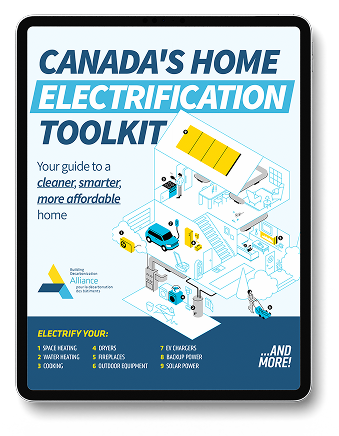
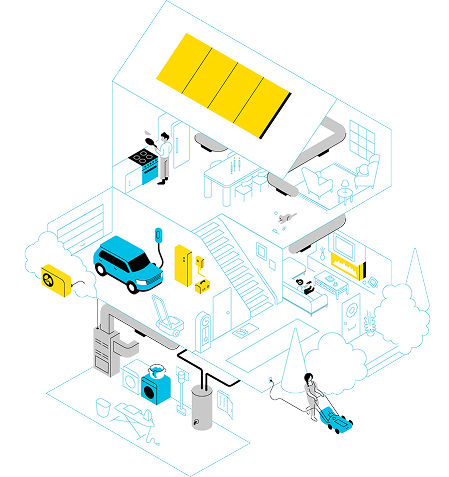
From fireplaces to furnaces and from lawn care to cooking, the range of electric equipment available to Canadian homeowners continues to grow. This electric technology has many advantages: It can be more efficient, quieter, more comfortable, and even more affordable in the long term—all in addition to reducing home emissions. But replacing fossil fuel-based equipment with modern electric equivalents can be a confusing task, leaving homeowners wondering where to start.
Developed by the Building Decarbonization Alliance, Canada’s Home Electrification Toolkit is designed to help Canadians understand the electric options available and factors to consider when replacing their fuel-burning appliances with electric equivalents. Written in plain language with details on costs, implementation, and emissions reduction potential for a variety of household equipment, the Toolkit empowers homeowners to plan for what equipment to replace and when, talk knowledgeably with tradespeople, and spread the word to inspire others to start their own electrification journeys.
Are you a public-facing organization with an interest in building decarbonization? Want to strengthen your connection to your stakeholders by providing them with the most up-to-date information about electrifying their homes? Make Canada’s Home Electrification Toolkit your own with our white-label versions.
We’ve designed the Toolkit with a range of options to meet your organization’s needs by adding your logo and brand colours throughout, and to update national data with appropriate details for your city, region, or province. Whether you want to share the whole document or just a specific section, let us know and we can help you inform and empower your audience.
Who needs a toolkit?
With many options to choose from in each area of the home, upgrades to wiring and electrical panels to navigate, and contractors potentially passing along outdated information and opinions, electrifying household equipment may seem too difficult for many households.
That’s where Canada’s Home Electrification Toolkit comes in. With clear, concise, and up-to-date information on space heating, cooking, fireplaces, home batteries and backup options, and other household equipment all in a highly polished and beautifully illustrated package, it is here to help empower your community on their electrification journey. In addition, the Toolkit also includes tips for renters, strategies for avoiding potentially costly electrical panel upgrades, and case studies from satisfied homeowners.
For the more technically inclined, the appendices provide details on operating costs and emissions by province and territory. All of it is intended to help Canadians experience the benefits of electrified equipment in a way that works with your home, your budget, and your timelines.
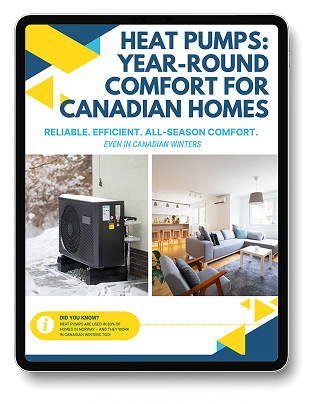
More Canadians are considering heat pumps, but many aren’t sure how they work, or if they can trust them in a cold climate. Developed with HRAI and Plumbing & HVAC Magazine, the Heat Pump Customer Education Tool helps contractors bridge that knowledge gap and make the case for heat pumps with confidence
Build trust by answering customer questions up front
Reinforce your expertise with the “What to Ask Your Contractor” checklist
Boost customer confidence in heat pump performance—even in Canadian winters!
Contractors who lead with education—not just pricing—win more business and overcome customer hesitation. Use this pamphlet as part of your sales conversations, leave it behind after quotes, or share it with customers who are still considering their options.
Creative Commons license
We want to get Canada’s Home Electrification Toolkit into the hands of every Canadian who is curious about the benefits of electrification, so we want it to be as straightforward as possible to share.
The Toolkit is published under a Creative Commons CC-BY-NC-SA 4.0 license, which means you are free to share, reuse, adapt, and remix it is you see fit, with a few requirements:
Attribution: You must give appropriate credit, provide a link to the license, and indicate if changes were made. You may do so in any reasonable manner, but not in any way that suggests the Building Decarbonization Alliance endorses you or your use.
Non-commercial: You may not use the material for commercial purposes.
ShareAlike: If you remix, transform, or build upon the material, you must distribute your contributions under the same license as the original, with no added legal terms or technological restrictions added.
To learn more about Creative Commons licensing, visit creativecommons.org.
Joining our alliance is simple, and doesn’t cost a thing.