This is the second post in Current Thinking, a series of what-if questions providing new perspectives on Canada’s building sector in the energy transition. Each instalment explores an emerging idea or approach with the power to spark important conversations and unlock the potential of modern, electrified buildings.
Heat pumps are one of the most important technologies enabling Canada’s transition to an electrified economy. As space heating is the largest user of building energy in Canada,1 heat pumps delivering both heating and cooling help residential buildings become active participants in the electrotech revolution.2 Yet in many provinces, the “spark gap” (the ratio between electricity and fossil fuel costs) limits the operational economics of electrification. What if we could shrink the spark gap to improve the affordability of clean heating?
Heat pump adoption correlates with the spark gap
Across Canada and Europe, heat pump adoption tends to be higher where the spark gap is lower (see Figure 1). This does not mean electricity prices alone determine adoption — upfront costs, incentives, contractor availability, consumer awareness and policy all matter. However, operating cost differences between electric and gas appliances are an important part of the investment decision for consumers and the industries that support them.
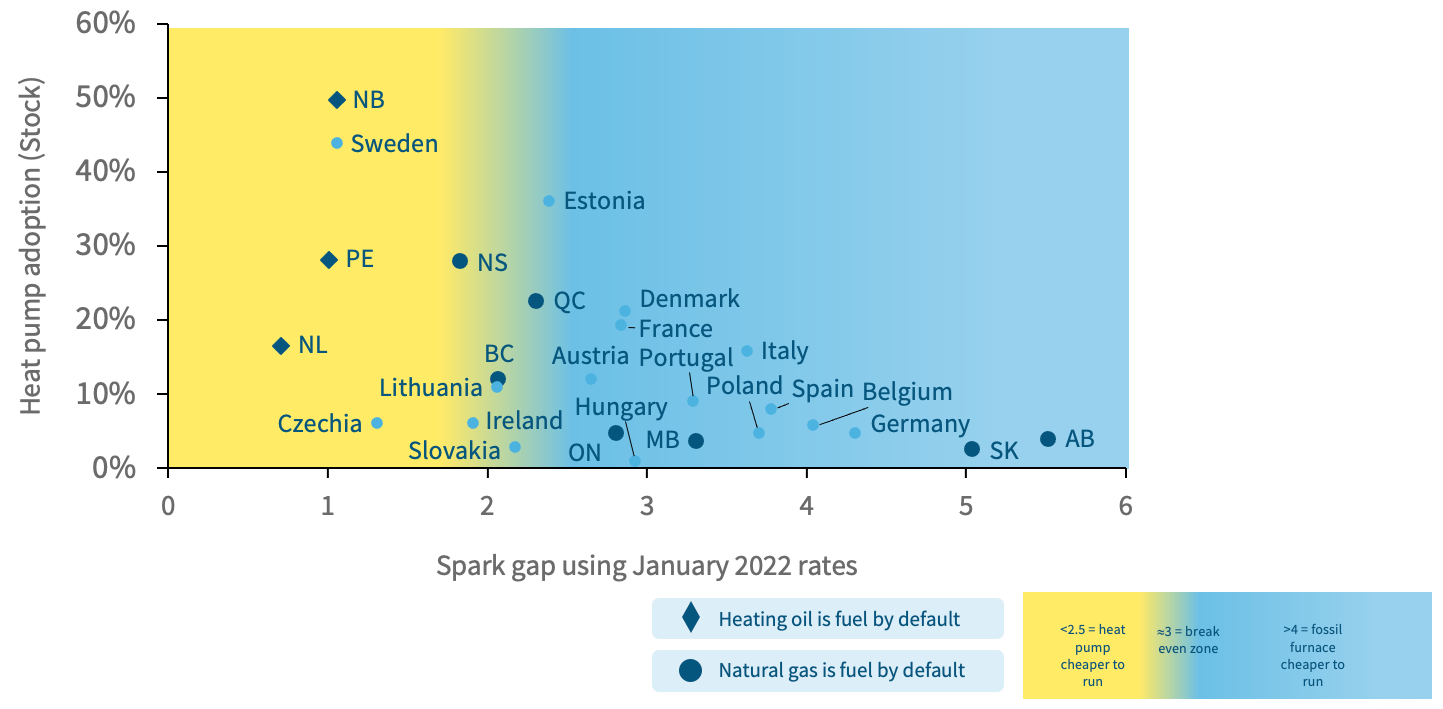
Figure 1: In provinces where the spark gap is lowest, there tends to be a greater portion of single-family homes that have installed heat pumps.3 This trend is also seen across the European Union.4 (using January 2022 utility rates by province, natural gas is the fuel by default except in NB, PE, NL where heating oil is used)
In general, when the spark gap is well below three due to high fuel rates (e.g. heating oil in New Brunswick) or low electricity rates (e.g. Quebec), heat pumps are lower cost to operate and their adoption is higher. This makes sense because heat pumps are roughly three times more energy-efficient than fossil-fuelled furnaces, which effectively cancels out the cost difference. The spark gap analysis focuses on current energy rates; future rates are highly uncertain as they reflect dynamic market conditions and regulatory and policy decisions, in addition to other factors.
Utility regulators and governments can shrink the spark gap
The spark gap is shaped not only by the cost of producing and procuring energy, but also by the decisions made on how those costs are recovered within the energy system. Both governments and their utility regulators can shrink the rate differential between electricity and heating fuels. We outline four strategies below to help lower the spark gap in the Canadian context.
1. Introduce rate structures that reward off-peak electricity use
As our buildings electrify, governments and utility regulators can keep overall electricity system costs down by ensuring that new demand is focused during periods when the generation, distribution and transmission infrastructure is underutilized while protecting the times when this infrastructure is significantly strained. Critical peak and dual fuel pricing are viable options already in use.5
Introduce critical peak pricing for electricity
Critical peak pricing offers lower rates most of the time but significantly higher rates during short, critical winter peak events when the electricity system is under stress (~4 hours in a stretch, a limited number of times per year). In this type of structure, households are advised in advance of an upcoming event, and in some areas smart thermostats can automatically reduce electricity use during these hours while minimizing impacts on comfort. The overall effect is to shrink the spark gap, making heat pumps more cost-competitive than fuelled heating. Quebec offers critical peak pricing (Rate Flex D) while Nova Scotia has piloted critical peak pricing.
Introduce dual fuel pricing for homes with hybrid heat pumps
Customers with hybrid heat pumps can benefit from dual fuel rates that are low most of the time but rise sharply when the electricity system is strained due to low outdoor temperatures. With simple thermostat programs, households can prioritize heating with the heat pump while electricity rates are low, and switch to gas below the threshold temperature avoiding the higher rate. This approach treats buildings as flexible energy resources rather than passive energy consumers. By making better use of existing electricity assets throughout the year, utilities can reduce overall costs while supporting the energy transition. Consumers benefit from lower overall electricity rates that also shrink the average spark gap and make heat pumps more economically attractive. Quebec has successfully used such “dual energy rates” (rate DT)6 for decades.
Call Out: Better smart thermostats could unlock even more savings
Today’s smart thermostats are smart, but are not smart enough to optimize for cost as rates change or when using hybrid heat pumps.
Smart thermostats can adjust heating to reflect daily schedules, avoid peak time-of-use rates, and many (but not all, yet)7 can respond to utility signals to automatically avoid critical peak rates.
However, households risk paying higher than necessary operating bills because programmable thermostats are still unable to automatically update to optimize savings as utility rates and rate structures change, in part because utilities are not consistent in how they publish their rate information.
For hybrid systems, a thermostat that can calculate the cost of heating with a heat pump or furnace depending on the current spark gap and the heat pump efficiency at the given outdoor temperature could switch between heating sources to maximize savings. Such thermostat settings do not yet exist, but a Hamilton, Ontario household could save 31% using this approach compared to an all-electric heat pump while using the heat pump for 55% of the annual heating load.8
2. Rebalance gas costs
Energy bills are typically made up of fixed fees that are stable month to month and variable fees that depend on how much energy is used. For natural gas and electricity, fixed fees typically cover things such as meter reading and administration costs, but how much of the energy delivery and distribution costs are allocated between fixed and variable fees can vary by province. When fixed fees are a higher percentage of annual household natural gas bills, the spark gap worsens along with the operational economics of switching from fueled systems to heat pumps. Having delivery and distribution costs reflect their variable nature and shifting them to variable fees is considered a fairer way to share costs,9 encourage electrification, and improve the economics of hybrid heating. Heat pump adoption today is highest in regions where fixed fees are a smaller share of annual gas bills (see Figure 2).
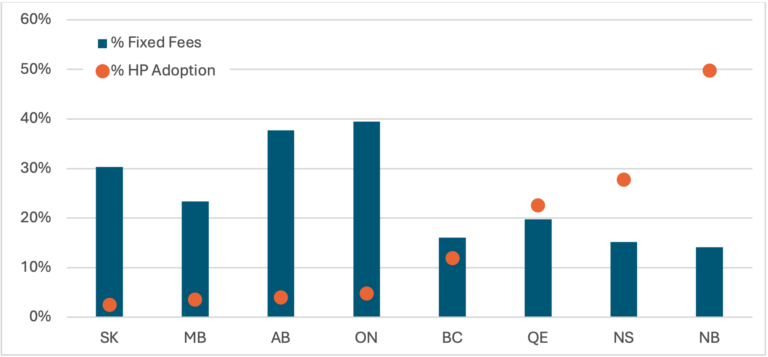
Figure 2: In provinces where fixed fees are responsible for a smaller share of annual gas bills, the spark gap is smaller, and heat pump adoption is higher (using July 2026 utility gas fixed and variable fees for gas space heating by province and modelled average single family home heating load for the largest city by province).
3. Require renewable natural gas (RNG) blends
Just as the Clean Electricity Regulations ensure our grid decarbonizes, RNG requirements can ensure gas utility supply does the same over time. Canada’s electricity system is already largely low emissions, and this represents an imbalance between the costs and benefits of electricity. Provinces can level the playing field by requiring the blending of RNG with natural gas to ensure remaining gas consumption becomes progressively lower carbon while also improving the relative economics of clean electric heating technologies. This is possible because as a low-carbon equivalent, RNG is more expensive than natural gas. For example, Quebec requires natural gas utilities to incorporate 5% RNG today, rising to 10% in 203010, while British Columbia will require a minimum of 15% RNG by 2030.11
4. Shift electricity system costs from ratepayers to taxpayers
Governments are investing in our electricity systems because electrification builds economic competitiveness and increases energy security. Governments can further shift electricity system costs from ratepayers to taxpayers through a range of mechanisms.12 This could lower system costs, while helping to keep electricity rates affordable, and shrink the spark gap while investments are being made to support further electrification. For example, in Ontario, residential bills include a provincially funded electricity rebate designed to help manage home energy bills.13
Conclusion
Heat pumps are one of the most important technologies supporting Canada’s transition to an electrified economy, but the price of the energy they use matters. Across Canada and internationally, heat pump adoption is higher where the spark gap is lower. Utility regulators and governments can use utility rate structures, RNG blending mandates, and shift electricity system costs to taxpayers to reduce the spark gap while also improving affordability, accelerating electrification, and helping buildings become flexible energy assets that strengthen Canada’s future electricity system.
Shrink the spark gap, and clean, electrified heat becomes a more affordable choice for Canadian homes.