This is the first post in Current Thinking, a series of what-if questions providing new perspectives on Canada’s building sector in the energy transition. Each instalment explores an emerging idea or approach with the power to spark important conversations and unlock the potential of modern, electrified buildings.
As Canada moves towards a more electrified economy, buildings will increasingly become active participants in the energy system. As electricity demand grows from building, transportation, and industrial electrification, the need for flexible resources and energy efficient alternatives that help manage peaks and reduce pressure on the grid will only increase. What if the millions of electric resistance storage tank water heaters (resistance WHs) already installed in homes across the country were leveraged to support our grid? Low-cost technologies are readily available to transform these devices into grid assets, but policies, market rules, and consumer awareness campaigns are needed to unlock their potential.
The potential of water heaters in Canada
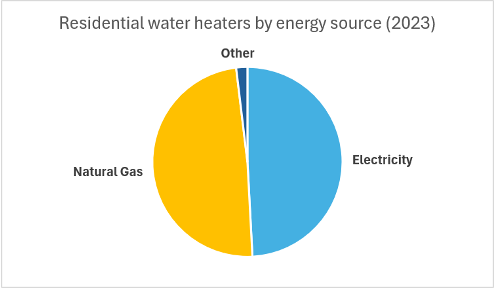
Electric storage water heaters are common in Canada
In 2023, 49% of Canadian homes used electricity to heat their water, representing over eight million households.1 The vast majority of those electric water heaters are resistance WHs.
Resistance WHs can be grid assets
By storing energy in the form of hot water for hours at a time, they divorce the timing of energy demand from hot water use. As such, they can be leveraged as a thermal battery to benefit the grid. For example, resistance WHs can shift demand away from grid peaks using smart controls in response to price signals such as time-of-use electricity rates without affecting hot water access.
Grid-connected resistance WHs can be used to relieve grid stress (e.g., when a transformer trips or a generator goes offline) or to avoid the curtailment of renewables.2 Unlike other household equipment used for demand response, water heaters can be controlled at no expense to comfort or convenience; there’s little to no impact on hot water access because they already store energy as heat.
The aggregated potential benefits of water heaters as thermal batteries are considerable
If all existing resistance WHs in Canada were to be grid connected, the potential peak reduction would approach 5-8 GW,3 although the realizable potential may be much less. Hydro-Quebec anticipates up to 0.3GW of peak reduction is possible through their smart (grid-connected) water heater program.4 As an illustration of the potential value, this represents an estimated $80 to $120 million per year in electric system capacity costs, using Hydro-Québec and BC Hydro’s avoided capacity costs values.5 In contrast, Ontario’s Peak Perks program reduced peaks by 0.2 GW in 2025 by controlling air conditioners,6 a strategy that can only be applied to summer peaks.
With time-varying pricing, households can save money by controlling resistance WHs
With electricity rate structures that vary by time to encourage off-peak use, households can save money by programming their resistance WHs to avoid times with peak rates. Time of use rates are used by some utilities to encourage off-peak use. They vary on a fixed daily schedule, while critical peak rates spike during a limited number of hours per year. For example, in Toronto, where ultralow overnight time-of-use rates are in place, a household that programs water heaters to avoid peak hours can reduce the cost of operating a resistance WH by 17% or $70/yr.7
Grid connecting water heaters is easier than ever
Wi-fi-connected controllers that add grid connecting abilities to existing resistance WHs are now available. For example, Hilo and Sinope (both made in Canada) have controllers that cost $100-$160 plus installation and which are already used by Hydro Quebec to reduce residential water heater demand during critical peak events. Incentives currently cover all or most of the costs for Hydro-Quebec customers who enroll in the program. Concerns of bacterial growth in underheated units are addressed by the smart controllers turning on the heating element if temperatures drop below a preset threshold.
Heat Pump Water Heaters are an energy-efficiency heavyweight that cut operating costs but offer less grid flexibility.
Three to four times as efficient as resistance WHs, Heat Pump Water Heaters (HPWHs) help owners save money on their utility bills. They’re the most affordable way to heat water in all provinces except Saskatchewan, where gas water heaters enjoy a small benefit. Compared to resistance WHs, operating a HPWH will save an average Canadian household $476/yr.8 However, their significantly higher upfront costs are a barrier to adoption, and HPWHs provide less demand shifting potential and have a small heating penalty and cooling benefit when installed in conditioned spaces.
Nevertheless, the energy efficiency benefits are attracting some developers. Notably, HPWHs made up 62% of new construction sales in the U.S. Northwest in 2024, with developers motivated in part to meet energy-efficient building codes. With water heating being the second-largest energy user and emissions producer,9 HPWHs can help new construction meet energy and emission performance targets such as those in ENERGY STAR for new homes, LEED for homes, and the BC Energy Step Code programs. Furthermore, Canada’s 2025 national building code regulates operational greenhouse gas emissions for the first time, which could drive increased interest in HPWHs for builders looking to achieve the highest tiers.
New policies and programs can tap the potential of electric water heaters
1. Modernize utility regulations and programs to enable and compensate distributed energy resources.
While water heaters can provide several grid benefits including reliability benefits and avoided infrastructure, capacity, and energy costs,10 existing regulatory and market frameworks often don’t recognize those benefits or compensate for their full value. The cost-effectiveness tests that demand-management programs use often don’t recognize the full benefits either, making the programs harder to develop and sustain when their benefits are undervalued, and mechanisms to allow aggregators to compete in procurement proceedings are often lacking.
Regulators, utilities, and governments can help by modernizing regulatory and market frameworks to fully integrate — and compensate — distributed energy resources (DERs). Measures could include demand-flexibility targets, competitive procurement of demand-side resources, improved DER valuation, and enabling third-party aggregation.11,12,13 The economic benefits are significant: in 2023, Brattle Group estimated that virtual power plants that aggregate flexible loads from U.S. residential buildings could reduce the cost of meeting peaks at 40-60% of the cost of alternatives, but they face technology, market, and regulatory barriers.14
2. Use electricity rate structures to activate demand-side flexibility and reward households for using resistance WHs for demand shifting.
When electricity use is reduced during peak hours, electricity system operators can defer infrastructure investments and reduce overall costs, but customers who pay flat and tiered electricity rates have no incentive to invest in technologies that can provide demand flexibility. Time of use and critical peak rates are a simple tool available to align the system and customer benefits for greater demand shifting. Time of use rates are currently available in British Columbia15 and Ontario,16 and are being piloted in Nova Scotia.17 Critical peak rates are an option only in Nova Scotia18 and Quebec.19
3. Increase awareness of resistance WH controllers and HPWHs.
Consumers and installers won’t choose to add resistance WH controllers or install HPWHs if they don’t know about them or don’t understand their full potential. Utilities, who also benefit from the technology, are logical sources of information for consumers. Raising awareness among installers is also critical, since consumers are strongly influenced by the recommendations of their installers. Installers must be confident in the reliability of HPWHs and resistance WH controllers and knowledgeable about how to complete a quality installation before staking their reputation on the products.
Summary
Canada has millions of thermal batteries sitting idle that could turn buildings into productive energy assets. With the addition of a low-cost controller, existing resistance WHs could shift demand and reduce grid peaks while saving households money. Meanwhile, HPWHs are another opportunity to lower household energy costs, cut energy use, and meet building performance standards. Tapping into the potential sitting in our water heaters is a matter of raising awareness and creating the market conditions to embrace this potential. Let us not allow this opportunity to run down the drain.
End notes
1. Natural Resources Canada. Comprehensive Energy Use Database. Residential Sector. Canada. Table 34: Water Heater Stock by Building Type and Energy Source
2. Podorson, D. (2016). Grid interactive water heaters – how water heaters have evolved into a grid scale energy storage medium. ACEEE Summer Study of Energy Efficiency in Buildings
3. Assuming 3-5 kW water heaters, 20% peak coincidence factor for resistance WHs and 8.3 million homes.
4. Hilo smart water heater controller
5. Estimation based on Hydro-Québec’s avoided capacity cost of $266/kW-year and BC Hydro 2025 Integrated Resource Plan Application of $410/kW-year. Also note that this estimate does not capture all potential non-energy benefits associated with demand flexibility, such as reliability benefits, and deferred infrastructure investments.
6. IESO 2025 Year in review
7. Using January 2026 Toronto Hydro electricity rates and shifting demand from on-peak to the hours before and after.
8. Population-weighted average assuming 15 GJ water heating load and using January 2026 utility rates for each province. Assumed water heater efficiencies of 92% (resistance WH), 383% (HPWH), and 62% (gas water heater). Heating penalty and cooling benefits from operating a HPWH were not included in the analysis.
9. Natural Resources Canada. Comprehensive Energy Use Database. Residential Sector. Canada. Table 2: Secondary Energy Use and GHG Emissions by End−Use
10. Dunsky 2026. BC distributed energy resource potential study. Clean Energy Canada
11. Shwisberg et al (2021). How to build clean energy portfolios. RMI
12. Hledik R. & Peters, K. (2023). Real reliability: the value of virtual power. The Brattle Group.
13. Pivnick E. (2025). Pay people instead of power plants for clean electricity. Clean Energy Canada.
14. Hledik R. & Peters, K. (2023). Real reliability: the value of virtual power. The Brattle Group.
15. BC Hydro Residential time-of-day pricing
16. Ontario Energy Board Managing costs with Time-of Use rates
17. Nova Scotia Power Residential rates
18. Nova Scotia Power Critical Peak Pricing Rate Pilot
19. Hydro Quebec Rate Flex D